
This post contains affiliate links. If you buy through our links, we may earn a small commission at no extra cost to you.
A clogged drain is almost always hair, grease, or soap buildup within 12 inches of the drain opening. Here’s the method that clears it fastest — and how to match the fix to the drain type.
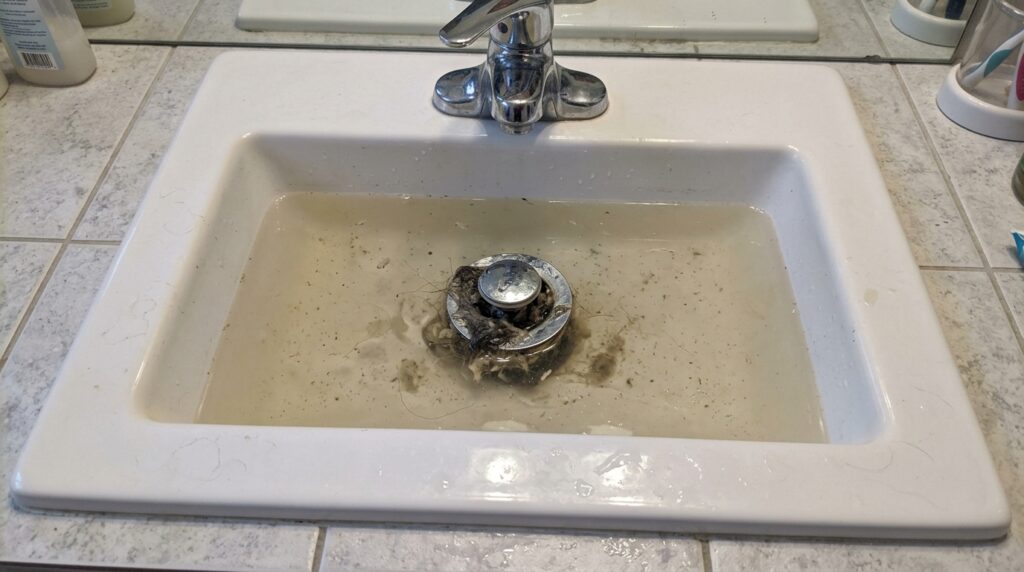
A clogged drain is one of the most common household problems — and one of the most over-complicated. Most clogs are hair, grease, or soap buildup sitting within 12 inches of the drain opening. The right tool clears them in under 10 minutes without chemicals, without a plumber, and without any special skills.
The method depends on the drain type. What works on a bathroom sink doesn’t always work on a kitchen sink. This guide covers every drain type and every method, ordered from fastest to most aggressive.
Quick answer: For bathroom drains — remove and clean the pop-up stopper or use a hair clog remover tool. For kitchen drains — plunge with a cup plunger or use a drain snake. For any drain — avoid chemical drain cleaners, which damage pipes and rarely clear hair clogs.
⭐ Essential Product:
Vastar Drain Snake Hair Clog Remover (6-pack) — flexible plastic with barbed edges that grab hair on extraction, 25 inches long, fits all standard drains. Around $8 for 6. Clears 80% of bathroom sink and shower clogs in under 2 minutes. The single most useful drain tool in the house.
For kitchen clogs: Ridgid 57043 Power Spin+ Drain Cleaner — attaches to any power drill, 25-foot cable, cuts through grease and food buildup in kitchen drains. Around $50. Faster and more effective than manual snaking for kitchen clogs.
Match the Method to the Drain
Different drains clog from different causes — the fix should match the cause.
| Drain | Most Common Clog | Best First Method |
|---|---|---|
| Bathroom sink | Hair + soap scum on pop-up stopper | Remove and clean stopper |
| Shower drain | Hair buildup at drain cover | Hair clog tool or remove cover and pull |
| Bathtub | Hair on stopper linkage | Remove stopper/linkage, clean |
| Kitchen sink | Grease + food buildup | Plunger, then drain snake |
| Utility/laundry | Lint + soap | Plunger, then snake |
| Floor drain | Debris + sediment | Snake + flush |
The fastest fix is always the one closest to the surface. Before reaching for tools, look at what’s visibly blocking the drain — more than half of bathroom sink and shower clogs are solved by removing the drain cover and pulling out the clog by hand or with the barbed plastic tool.
Method 1: Remove the Stopper or Cover (Bathroom Sink, Tub)
Time: 2–5 minutes. Clears roughly 70–80% of bathroom sink clogs.
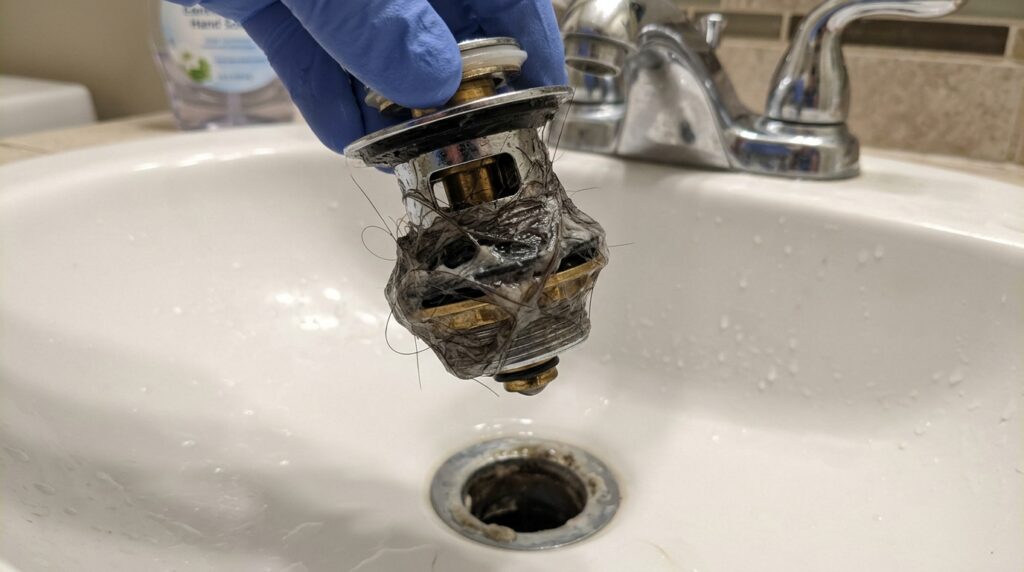
Bathroom Sink Pop-Up Stopper
- Reach into the drain and try to lift the stopper straight up — many lift out with no tools
- If it doesn’t lift, look under the sink for the pivot rod (a horizontal rod connecting to the drain pipe) — loosen the clip or nut holding it and slide the stopper out
- Pull the hair and soap plug off the stopper — it will be unpleasant
- Rinse the stopper, reinstall, and test
Shower Drain Cover
- Remove the drain cover (usually one or two screws, or pry up with a flathead)
- Shine a flashlight into the drain — the clog is usually visible within 4–6 inches
- Insert the barbed plastic drain tool, rotate to grab hair, and pull straight up
- Repeat until no more material comes out
- Replace the cover and run hot water for 30 seconds
Method 2: Plunger (Kitchen Sink, Any Drain with Standing Water)
Time: 5–10 minutes. Best for grease and food clogs in kitchen drains.
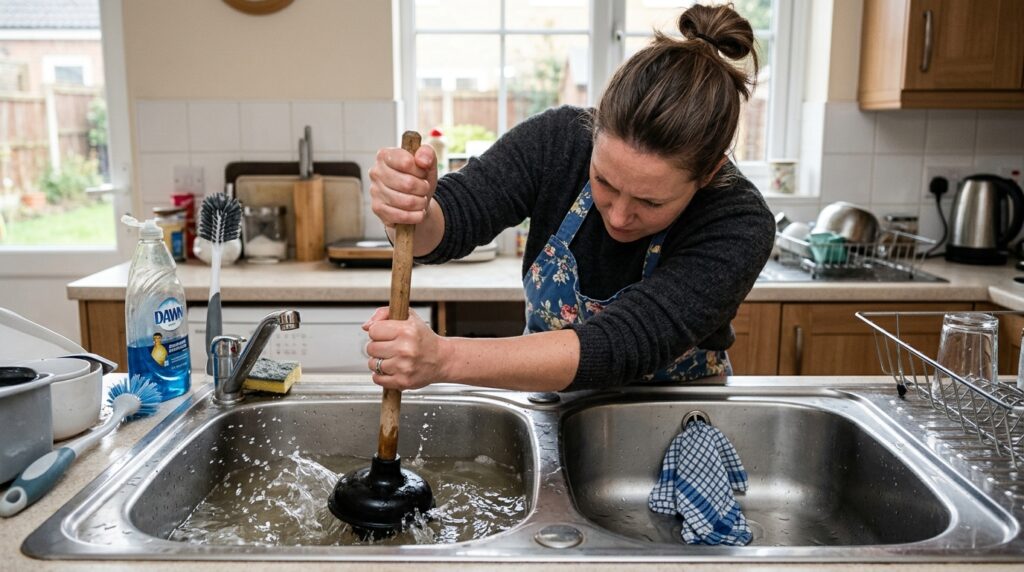
Use a cup plunger (flat bottom) for sinks — not a flange plunger, which is for toilets.
Technique
- Add water to the sink until the plunger cup is submerged (2–3 inches of water)
- Cover the overflow hole (the small hole near the top of the basin) with a wet rag — this is critical for building pressure
- Place the cup directly over the drain and press down to seal
- Plunge with firm, quick strokes — 10–15 pumps, then pull up sharply on the last stroke
- Repeat 2–3 times, then run hot water to test
For double kitchen sinks: Plug one drain tightly while plunging the other — otherwise pressure escapes through the connected drain.
Our Pick: MR.SIGA Toilet Plunger and Bowl Brush Combo — heavy-duty flange plunger + toilet brush with holder, black. Around $24.
Method 3: Baking Soda and Vinegar Flush
Time: 25–30 minutes. Best for soap scum and light grease buildup — not for hair clogs.
- Pour 1/2 cup baking soda directly into the drain
- Follow with 1/2 cup white vinegar — fizzing is the reaction working on buildup
- Plug the drain immediately to direct the reaction downward
- Wait 20 minutes
- Flush with 2 cups of boiling water (or hot tap water for PVC pipes)
This method works best as monthly maintenance to prevent buildup — not as a primary fix for a fully clogged drain. For hair clogs, skip this and go straight to Method 1 or 4.
Method 4: Drain Snake / Hair Clog Remover Tool
Time: 5–10 minutes. Clears clogs that plunging and stopper removal can’t reach.
Plastic Barbed Tool (Bathroom Drains)
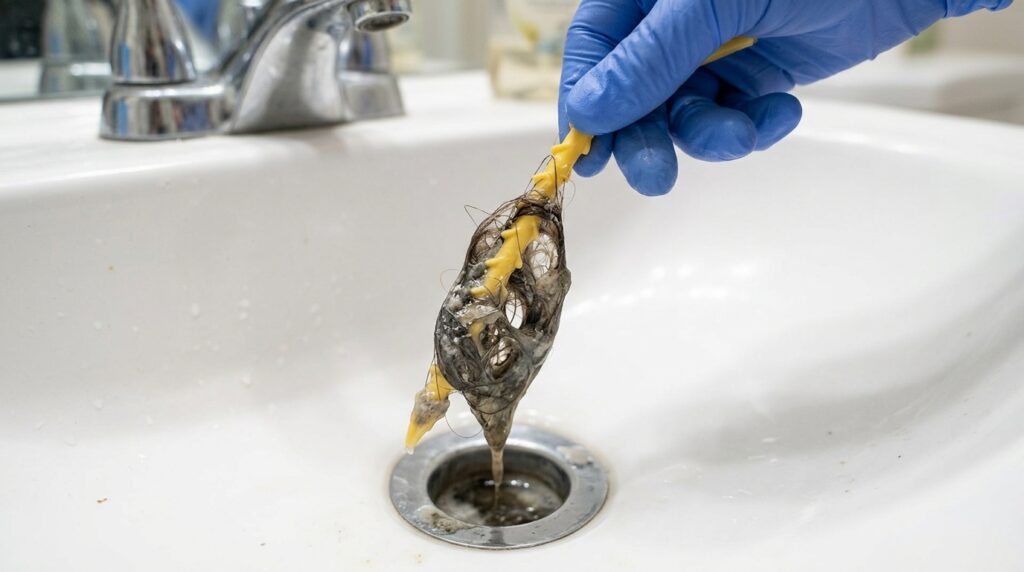
The Vastar-style plastic tool with barbs handles 80% of bathroom sink and shower clogs — it’s the first thing to try after stopper removal.
- Insert the tool into the drain as far as it will go (usually 18–24 inches)
- Rotate slowly while pushing — the barbs catch hair
- Pull out slowly — bring as much material as possible in one pull
- Repeat 2–3 times, then flush with hot water
Manual Drain Snake (Kitchen and Deeper Clogs)
For clogs beyond the reach of the plastic tool or for kitchen grease clogs:
- Feed the cable into the drain until you feel resistance
- Lock the cable and rotate the handle clockwise — this either breaks up the clog or hooks it
- Pull back slowly — if you hooked the clog, it will come out with the cable
- Feed the cable in again to catch anything remaining
- Flush thoroughly with hot water
Our Pick — Manual Snake: Ridgid 59787 3-Foot Hand Auger — 3/8-inch cable, works in bathroom and kitchen drains, fits under sinks without removing P-trap. Around $25.
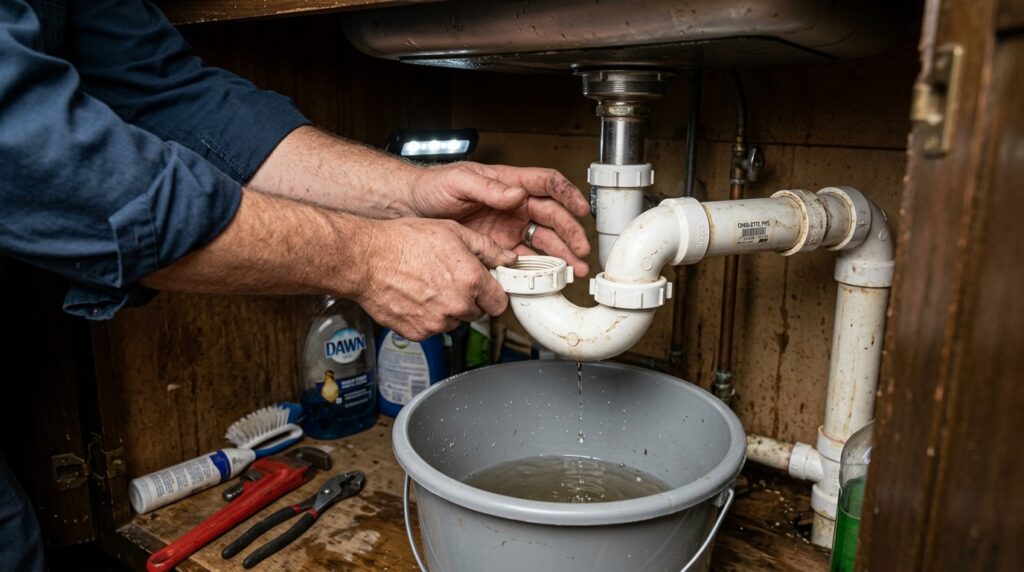
Method 5: Clean the P-Trap (Kitchen Sink, Persistent Clogs)
If plunging and snaking don’t clear the drain, the clog may be in the P-trap — the curved pipe section directly under the sink.
- Place a bucket under the P-trap
- Loosen the slip nuts on each end of the curved section by hand or with pliers
- Remove the P-trap — water and debris will fall into the bucket
- Clean out the trap and inspect the pipe opening in the wall for blockage
- Reinstall the P-trap hand-tight, turn on the water, and check for leaks
The P-trap is where grease and food buildup accumulates in kitchen sinks — it’s often the actual location of clogs that seem to resist all other methods.
Drain Unclogging Quick Checklist
Bathroom sink:
Pop-up stopper removed and cleaned
Barbed plastic tool run through drain 2–3 times
Flushed with hot water
Shower / tub:
Drain cover removed
Barbed tool or hand removal of visible hair
Cover reinstalled and tested
Kitchen sink:
Overflow hole plugged before plunging
Plunged 10–15 strokes, repeated 2–3 times
Drain snake used if plunging insufficient
P-trap cleaned if snake didn’t clear it
Any drain — if still clogged:
Multiple drains slow? → Main line issue, call a plumber
Gurgling in other drains? → Vent stack problem, call a plumber
Standing water after all methods? → Professional hydrojetting
When to Call a Plumber
DIY methods handle the vast majority of household drain clogs. Call a plumber when:
- Multiple drains are slow simultaneously — indicates a main line blockage, not a single drain clog
- Gurgling from other drains when water drains anywhere — pressure in the vent stack, not a simple clog
- Sewage smell from drains — potential main line issue or dried P-trap
- The same drain clogs repeatedly within days — could indicate root intrusion or pipe damage
- Standing water doesn’t move after all methods above — may need professional hydrojetting
Why You Should Avoid Chemical Drain Cleaners
Liquid Drano and similar chemical drain cleaners are the default solution most homeowners reach for — and the least effective for the most common clogs.
The problems:
- Don’t dissolve hair — the most common bathroom drain clog. They soften it temporarily, often creating a worse blockage deeper in the pipe
- Damage pipes over time — the caustic chemicals that dissolve organic material also degrade pipe joints and older metal pipes
- Hazardous to handle — splash risk to skin and eyes
- Incompatible with some pipe materials — can crack PVC in older installations
The alternative: A $8 pack of plastic drain tools clears hair clogs faster and more completely than any chemical. For kitchen grease, hot water + plunger + enzyme cleaner (not caustic) is more effective and pipe-safe.
Frequently Asked Questions
What’s the fastest way to unclog a drain? For bathroom drains — the barbed plastic hair tool, used immediately after removing the stopper. Clears most bathroom clogs in under 2 minutes. For kitchen drains — a cup plunger with the overflow hole plugged. Both methods are faster than any chemical treatment.
Why does my drain keep clogging after I clear it? Recurring clogs within 1–2 weeks indicate the clog isn’t fully cleared or there’s a deeper issue. Run the drain tool 4–5 times instead of 2–3. If it still returns quickly, clean the P-trap — the remaining material is likely lodged there. A drain that clogs monthly is signaling the need for a hair catcher over the drain opening.
Can I use boiling water on any clogged drain? Boiling water is safe for metal pipes and effective on grease and soap clogs. For PVC pipes, use the hottest tap water instead — boiling water can soften PVC joints over time. The temperature of tap water at maximum heat is still effective for most soap and light grease buildup.
How do I prevent drain clogs? Three habits: install a hair catcher over every bathroom drain (empties weekly in 30 seconds), run hot water for 30 seconds after each kitchen sink use to flush grease down before it cools and sticks, and do a monthly baking soda + vinegar flush. These three prevent the vast majority of household drain clogs.
My kitchen drain gurgles when the dishwasher runs. Is that a clog? Gurgling during dishwasher drain cycles often indicates a partial blockage in the shared drain line, or that the dishwasher drain hose isn’t properly installed with a high loop or air gap. Try plunging the kitchen sink drain first. If the gurgling continues, check the dishwasher drain hose installation.
The Bottom Line
Most drain clogs clear in under 10 minutes with a $8 plastic hair tool or a cup plunger — no chemicals, no plumber, no special skills. Match the method to the drain type: stopper removal and hair tools for bathroom drains, plunger and snake for kitchen drains.
For drain-specific deep dives, our guides on how to unclog a bathroom sink, how to unclog a shower drain, and how to unclog a kitchen sink cover each drain type with full step-by-step detail.
Have questions about your specific drain situation? Leave a comment below.
Related posts: