
This post contains affiliate links. If you buy through our links, we may earn a small commission at no extra cost to you.
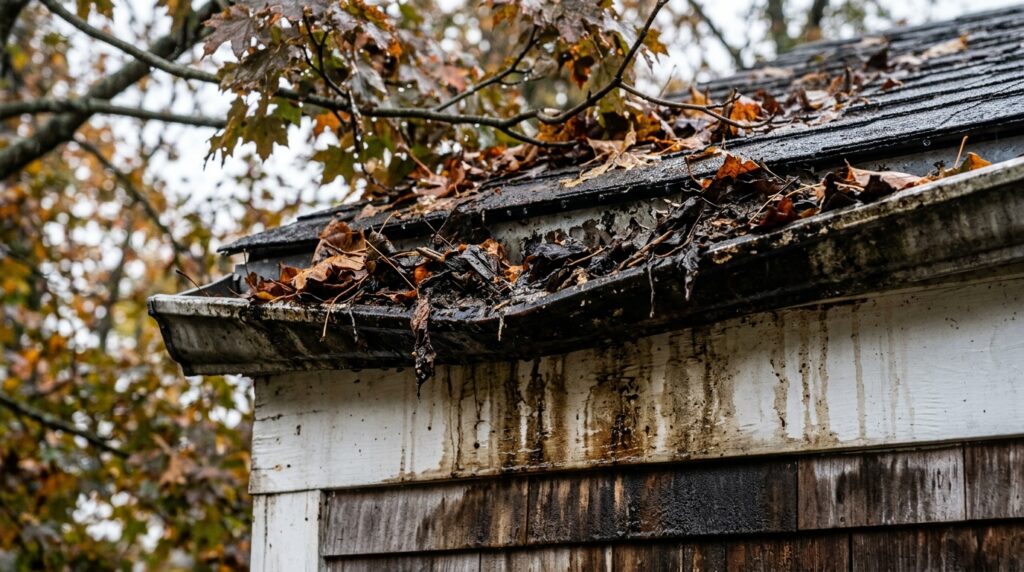
Clogged gutters are one of the most expensive neglected maintenance tasks in a home. When gutters can’t drain, water backs up under shingles, saturates fascia boards, pools against the foundation, and seeps into basements. The repair bill for any of those outcomes dwarfs what it costs to clean gutters twice a year.
The task itself is straightforward — it’s the ladder that intimidates most homeowners. With the right setup and a methodical approach, cleaning gutters takes 1–2 hours for a typical single-story home.
Quick answer: Set up a stable ladder, work in sections from the downspout outward, scoop debris into a bucket, flush the gutter with a hose to check flow, then clear the downspout. Do it every fall after leaves drop and every spring after trees finish budding.
What You’ll Need
- Extension ladder (stabilizer attachment strongly recommended)
- Work gloves (heavy-duty — gutter debris is sharp and harbors bacteria)
- Gutter scoop or garden trowel
- 5-gallon bucket with hook (to hang on the ladder)
- Garden hose with spray nozzle
- Plumber’s snake or drain auger (for stubborn downspout clogs)
- Safety glasses
Our Top Pick — Gutter Scoop: Amerimax Home Products Getter Gutter Scoop — flexible plastic conforms to gutter shape, won’t scratch aluminum. Around $9. Purpose-built tool that beats a garden trowel every time.
Our Pick — Hose Nozzle: Gilmour Thumb Control Watering Nozzle — adjustable spray patterns, comfortable grip, good pressure for flushing gutters. Around $16.
Our Pick — Ladder Stabilizer: Startingtool Adjustable Ladder Stabilizer — heavy-duty steel, adjustable standoff keeps ladder away from gutters and windows, fits most extension ladders. Around $43.
Step 1: Safety First — Ladder Setup
More people are injured cleaning gutters than doing almost any other home maintenance task. The ladder is where most accidents happen — not the gutter work itself.
Rules that keep you safe:
- Never lean a ladder directly against the gutter. Aluminum gutters dent and bend under ladder pressure, and a bent gutter can cause the ladder to slip sideways. Use a ladder stabilizer that contacts the wall or roof, not the gutter.
- Set the ladder on firm, level ground. On soft ground, use ladder levelers or a board under the feet.
- Maintain three points of contact at all times — two feet and one hand, or two hands and one foot.
- Never reach more than arm’s length to either side. Move the ladder instead. Overreaching is how falls happen.
- Work alone cautiously. Have someone nearby who knows what you’re doing.
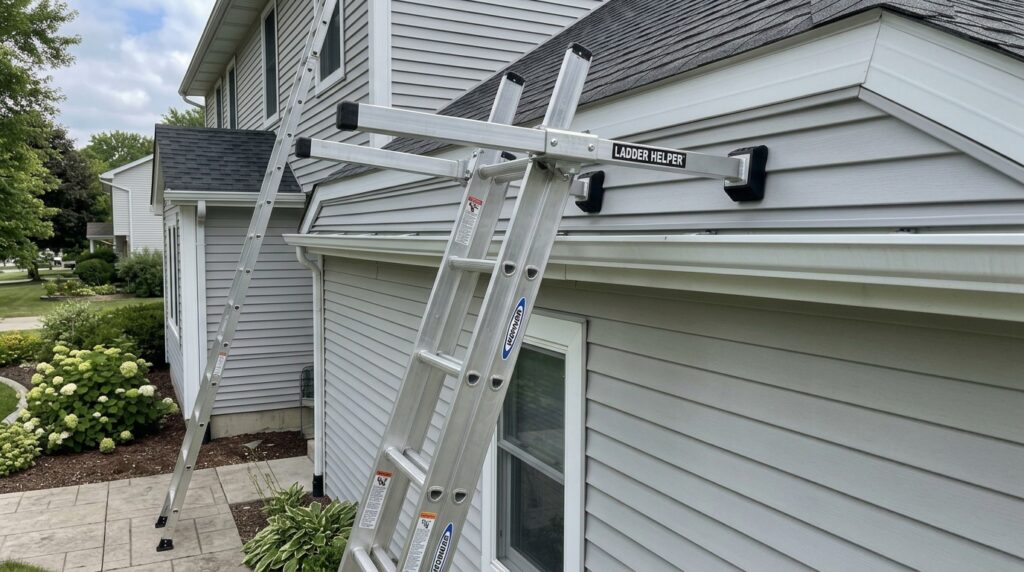
⚠️ For two-story homes or steeply pitched roofs, consider hiring a professional. The cost of gutter cleaning ($100–$250) is far less than an ER visit. This guide is written for single-story homes and accessible second-story gutters.
Step 2: Prepare Your Work Area
Lay a tarp on the ground under your work area — gutter debris is messy and the tarp makes cleanup a 2-minute job instead of raking wet leaves off the lawn.
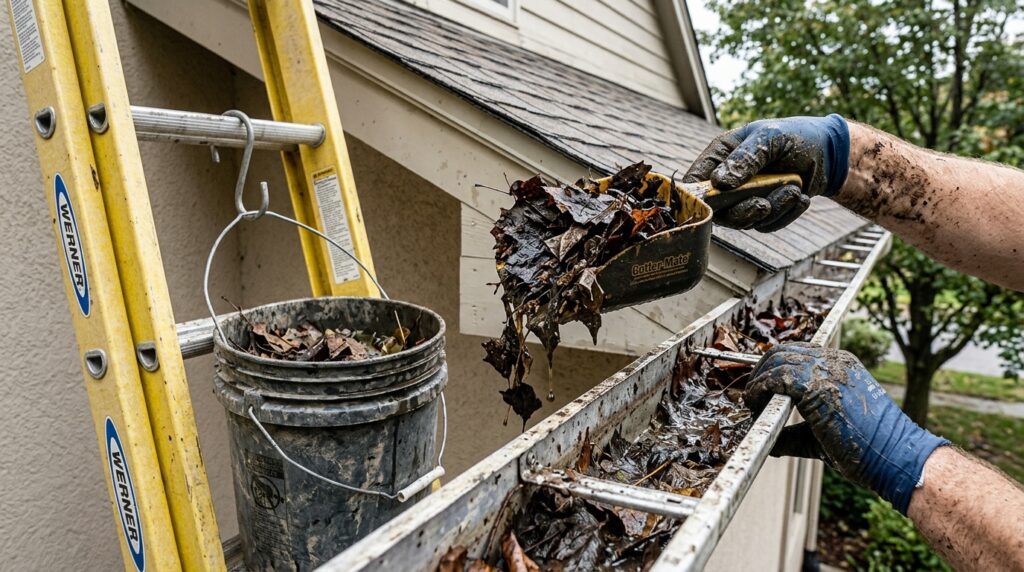
Hang a 5-gallon bucket on the ladder using an S-hook. This keeps both hands free and prevents you from dropping debris on yourself or making dozens of trips down the ladder.
Put on your gloves and safety glasses before going up. Gutter debris regularly contains decomposed leaves, bird droppings, wasp nests, and standing water — gloves are not optional.
Step 3: Scoop Out the Debris
Start at the end of the gutter farthest from the downspout and work toward it. This pushes debris toward the drain rather than past it.
Use the gutter scoop to pull debris out in sections, depositing it into your bucket. Work methodically — don’t try to clear large sections in one swipe. Wet, compacted debris is heavy.
What you’ll find:
- Decomposed leaves (most common — smells earthy, easy to scoop)
- Granules from roof shingles (fine dark grit — normal, doesn’t indicate a problem unless excessive)
- Twigs, seed pods, and pine needles
- Wasp or bird nests (work carefully around these — use a stick first to check for activity)
- Standing water (if present, the gutter isn’t draining — check the slope before moving on)
Empty your bucket into a garbage bag on the tarp below. Don’t dump debris off the roof or toss it onto the lawn — it’s a mess and the seeds will sprout.
Step 4: Check and Adjust the Gutter Slope
While the gutter is empty, check its slope. Gutters should pitch slightly toward the downspout — typically 1/4 inch of drop per 10 feet of run.
How to check: With a level placed in the empty gutter, the bubble should be slightly off-center toward the high end. If water pools in the middle or at the wrong end, the gutter has sagged.
How to fix a sagging section: Gutters are held by spikes or hidden hangers. Sagging means a hanger has pulled out of the fascia. Re-secure it with a new hidden hanger screwed into solid fascia board or a rafter tail.
This is worth checking while you’re up there — a gutter with proper slope stays cleaner longer because debris doesn’t sit in standing water and decompose.
Step 5: Flush the Gutters with a Hose
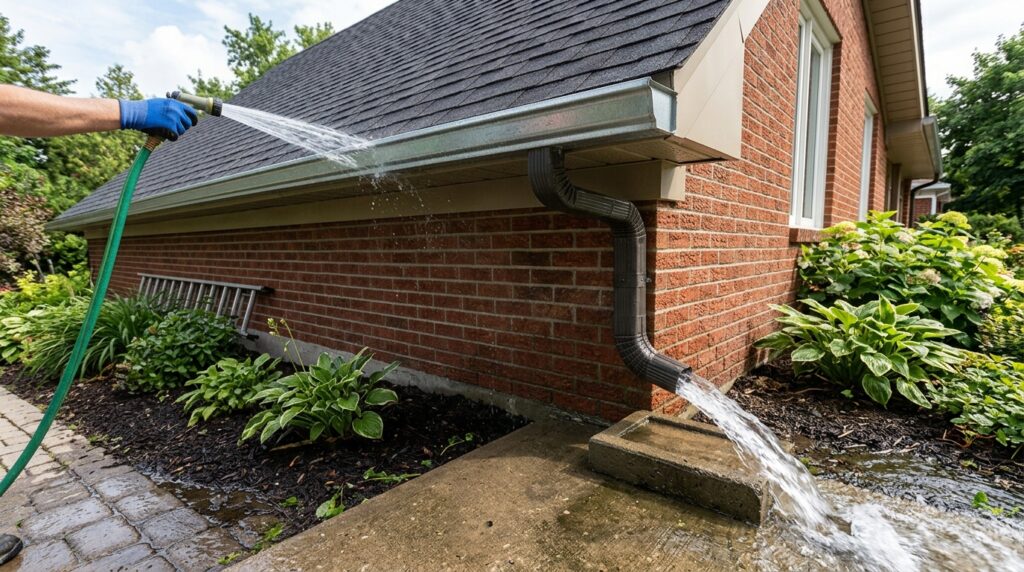
After scooping, flush each section with a garden hose starting at the far end and working toward the downspout. Use good pressure — this clears fine debris the scoop missed and tests drainage.
What to look for:
- Water flowing smoothly toward the downspout ✅
- Water backing up or pooling → slope problem or partial blockage still present
- Water dripping from seams or end caps → sealant has failed (see Step 6)
- Water running behind the gutter → gutter has pulled away from fascia
Flush until the water running out of the downspout is clear.
Step 6: Clear the Downspout
The downspout is where clogs concentrate. Even after flushing the gutter, the downspout may be partially or fully blocked.
Test: Put the hose into the top of the downspout at full pressure. If water backs up immediately rather than flowing through, you have a clog.
Clear it:
- Try the hose at full pressure first — this dislodges many clogs
- If that fails, feed a plumber’s snake down from the top
- For ground-level cleanout access (a small elbow at the bottom of the downspout), open it and snake from the bottom up
Once clear, flush again from the gutter to confirm unobstructed flow.
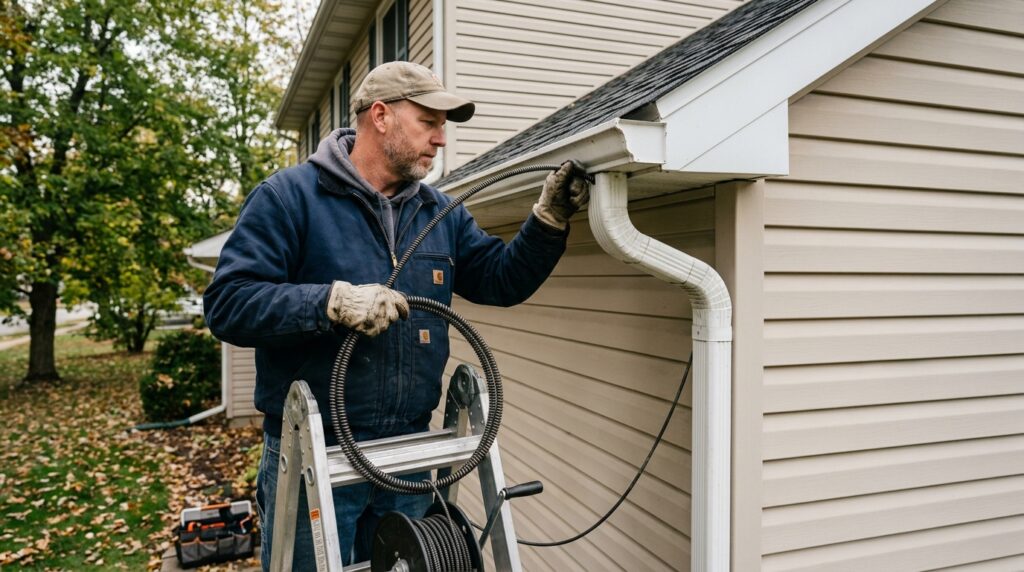
Step 7: Inspect and Seal Any Leaks
While you have the ladder out, check gutter seams, end caps, and the joint where the downspout meets the gutter for cracks or gaps.
Resealing a gutter joint takes 5 minutes:
- Dry the area completely
- Apply gutter sealant along the joint from the inside
- Smooth with a gloved finger
- Let cure per product instructions (usually 24 hours)

Our Pick: Flex Seal Liquid Rubber Sealant — brush-on, waterproof, flexible when cured, works on aluminum and vinyl gutters. Around $20.
How Often Should You Clean Gutters?
| Situation | Frequency |
|---|---|
| Average home, deciduous trees nearby | Twice a year (fall + spring) |
| Heavy tree coverage (pine, oak, maple) | 3–4 times a year |
| No trees within 30 feet | Once a year (fall) |
| After any major storm | Check and clear if needed |
Fall is the most important cleaning — after leaves have dropped but before the first freeze. Clogged gutters in winter fill with ice, which is heavy enough to tear gutters off the fascia and back water under shingles.
Spring cleaning catches the seed pods, pollen, and small debris that accumulates during budding season.
Should You Install Gutter Guards?
Gutter guards reduce cleaning frequency — they don’t eliminate it. The promise of “never clean again” is marketing. Here’s the honest breakdown:
| Type | Cost | Performance |
|---|---|---|
| Screen/mesh guards | $1–3/ft DIY | Blocks large debris, lets small debris through |
| Micro-mesh guards | $3–8/ft DIY | Best performance, blocks most debris |
| Foam inserts | $2–4/ft | Easy install, traps debris inside foam over time |
| Professional systems (LeafGuard, etc.) | $15–45/ft installed | Most effective, expensive |
Best DIY option: Raptor Micro-Mesh Gutter Guard — stainless steel micro-mesh, fits standard 5-inch gutters, cuts with tin snips. Around $2/ft. Reduces cleaning to once a year for most homes.
Gutter guards make the most sense if you have heavy tree coverage and currently clean 3–4 times a year. For average coverage, bi-annual cleaning without guards is often the practical choice.
Frequently Asked Questions
How do I know if my gutters need cleaning? Four signs: water overflows during rain (even light rain), you see plants growing in the gutter, water stains on the siding below the gutter line, or it’s been more than a year since the last cleaning. If any of these are true, clean them now.
Can I clean gutters from the ground? Partially. Gutter cleaning wands attach to a garden hose and let you flush debris from ground level — useful for maintenance between full cleanings. They don’t let you scoop packed debris or inspect the gutter condition. Use a wand for quick flushes, a ladder for full cleanings.
What happens if I never clean my gutters? Progressive damage: first, fascia boards rot from constant moisture contact. Then water infiltrates the soffit. Then it works back under shingles. Then it enters the attic or wall cavity. Foundation damage from water pooling at the base is also common. The sequence takes years, but the repair costs are significant — often $2,000–$10,000+ depending on what’s affected.
Is it safe to clean gutters myself? For single-story homes with a good ladder and a stabilizer, yes — with the precautions in Step 1. For two-story homes, steep pitches, or anyone uncomfortable on ladders, hire a professional. The risk-reward calculus shifts clearly toward professional cleaning above one story.
How much does professional gutter cleaning cost? Typically $100–$200 for a single-story home and $150–$350 for two stories, depending on linear footage and region. Most services include inspection and downspout clearing. Worth it annually if you’re uncomfortable on ladders — far cheaper than the water damage that results from neglect.
The Bottom Line
Gutter cleaning is unglamorous but non-negotiable. Twice a year — fall after leaf drop, spring after bud season — is the standard schedule for most homes. The tools cost under $50 total and the job takes under two hours.
The ladder is the only real risk, and it’s manageable with a stabilizer and the rules in Step 1. Get the setup right and the rest is just scooping and flushing.
For your full fall maintenance checklist, our room-by-room winterizing guide covers everything else that needs attention before the cold sets in — gutters first, then the rest of the house.
Have questions about your specific gutter situation? Leave a comment below.
Related posts: