
This post contains affiliate links. If you buy through our links, we may earn a small commission at no extra cost to you.
A disorganized closet costs you time every morning — digging for clothes, finding nothing to wear despite a full closet, and starting the day frustrated. The problem is almost never lack of space. It’s lack of system.
Organizing a closet properly takes a few hours and the right approach. The result is a space where everything is visible, accessible, and easy to put back — which is the only way a system actually stays organized.
Here’s how to do it from start to finish.
Quick answer: Empty the closet completely and declutter aggressively — keep only what fits and what you’ve worn in the past year. Measure the space, then maximize vertical storage with a double hang rod for short items and shelving above and below. Group by category, put daily items at eye level, and use slim velvet hangers to reclaim 30–40% more rod space.
Step 1: Empty and Declutter
You can’t organize a closet with too many clothes in it. The first step is always reduction — and it’s the step most people rush or skip entirely.
Empty the closet completely. Pull everything out — clothes, shoes, boxes, whatever’s been living on the floor. Lay it all on the bed or floor where you can see it. This is uncomfortable, which is why it works: you can’t avoid confronting what you actually own.
Keep only what fits and what you wear. The rule: if it doesn’t fit right now (not ‘when I lose weight’), it goes. If you haven’t worn it in 12 months, it goes. If you don’t like how it looks on you, it goes. Sentimental exceptions are fine — but limit them to a small box, not an entire shelf.
Sort into three piles: Keep, Donate, Trash. Donate anything in good condition. Trash anything stained, torn, or unwearable. Don’t create a ‘maybe’ pile — it always ends up back in the closet.
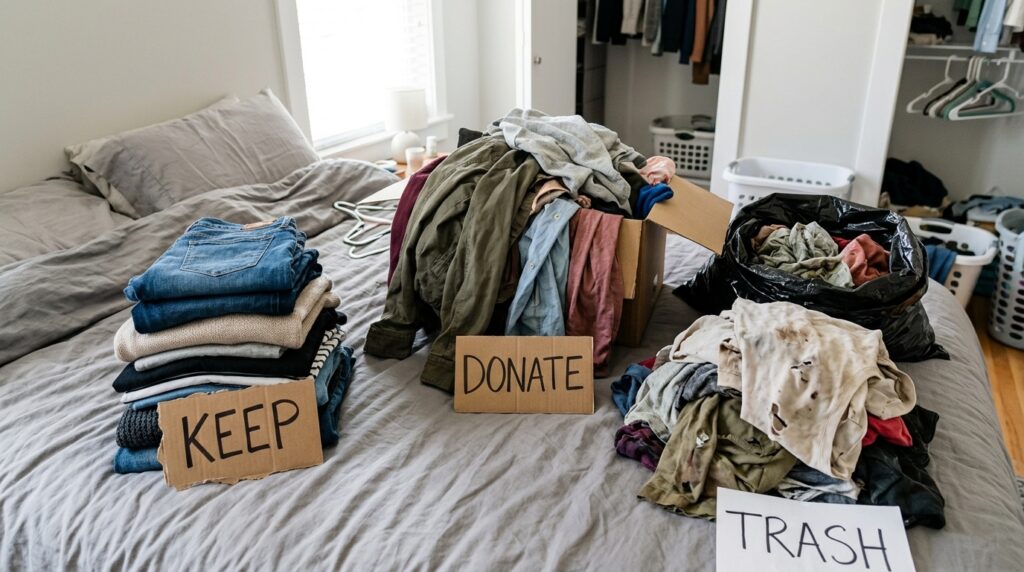
Deal with seasonal items separately. Winter coats, heavy sweaters, and off-season clothes don’t belong in a bedroom closet year-round. Store out-of-season items in bins under the bed, in a hall closet, or in vacuum bags to free up prime closet space for current-season clothes.
💡 Pro tip: The one-year rule has one exception: formal wear. A suit or dress worn once a year still earns its spot. Everything else follows the 12-month rule without mercy.
Step 2: Measure and Plan Your Layout
Before buying any organizers, measure your closet and plan what goes where. Buying first and measuring second is the most common and expensive closet organization mistake.
Measure width, height, and depth. Standard reach-in closets are 24–30 inches deep and 5–8 feet wide. Walk-in closets vary widely. Note the exact dimensions before shopping for any rod extensions, shelving, or organizer systems.
Identify your clothing mix. Count how much you have that’s long-hang (dresses, suits, coats) vs. short-hang (shirts, jackets, folded pants). This determines how much double-hang rod space you need vs. single-hang.
| Clothing type | Hang space needed | Storage approach |
| Shirts, jackets, folded pants | Short hang (40″ or less) | Double hang rod — two rods stacked |
| Dresses, suits, coats | Long hang (60″+ clearance) | Single rod, full height |
| Shoes | Floor or shelves | Clear boxes or angled shoe shelves |
| Folded items (sweaters, jeans) | Shelf space | Shelves with dividers or bins |
| Accessories, bags | Hooks or shelf bins | Hooks on walls or door organizers |
Sketch your layout before buying. A simple hand-drawn diagram — where the rods go, where the shelves go, what goes at eye level vs. high up — saves money and rearranging. Plan for how you actually use the closet, not how you wish you would.
Step 3: Maximize Vertical Space
Most closets come with a single rod and one shelf above it — which uses maybe 40% of the available space. Maximizing vertical space is where you gain the most storage without adding square footage.
Add a double hang rod for short items. If you have mostly shirts, jackets, and pants, adding a second rod below the first effectively doubles your hanging capacity. A simple rod extender hooks onto the existing rod — no tools, no installation. For a more permanent solution, a closet organizer system with double hang sections is more stable.
🔗 Our Top Pick: SONGMICS Closet Organizer System with Double Hang Rods (Amazon)
Use the space above the top shelf. The area between the top shelf and the ceiling is often completely wasted. Add another shelf or use clear bins to store off-season items, extra bedding, or anything you access only occasionally.
Use the floor strategically. The floor under hanging clothes is prime real estate. For short-hang sections, there’s typically 3–4 feet of clearance — enough for a shoe rack, a small dresser, or a stackable bin system.
Slim velvet hangers are non-negotiable. Replacing bulky plastic hangers with slim velvet hangers reclaims 30–40% more rod space in most closets. They also grip clothes so items don’t fall off and slide to one end of the rod.
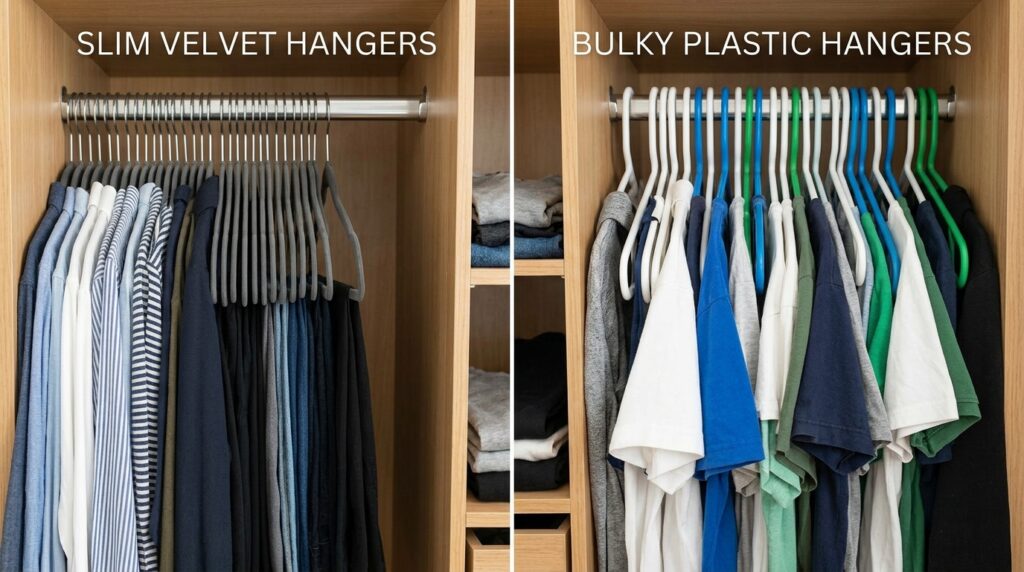
🔗 Our Top Pick: Utopia Home Premium Velvet Hangers 50-Pack (Amazon)
💡 Pro tip: Turn all your hangers backward when you finish organizing. After 6 months, anything still hanging backward hasn’t been worn — strong candidates for the donate pile at your next declutter.
Step 4: Organize by Category and Frequency
Where things live in your closet should reflect how often you use them. Daily items at arm’s reach. Occasional items higher up or further back. Rarely used items in the least accessible spots.
Group by category first. All shirts together, all pants together, all jackets together — not mixed by color or outfit. Category grouping makes finding things faster and makes it obvious when a category has too much.
Then arrange by frequency within each category. The clothes you wear most often go at eye level and within easy reach. Special occasion items go to the outer edges or higher shelves.
Color code within categories (optional). Arranging shirts light to dark within the shirts section makes it faster to find specific items and keeps the closet looking intentional. It takes about 10 minutes and pays off every morning.
Keep like items visible. If you can’t see it, you won’t wear it. Avoid stacking folded items more than 3–4 high. Use shelf dividers to keep piles from toppling. Clear bins on shelves let you see contents without removing everything.
Step 5: Add the Right Accessories
A few well-chosen accessories make the difference between a closet that looks good on day one and one that functions well for years.
Clear shoe boxes. Stackable clear shoe boxes keep shoes dust-free, visible, and protected — and stack efficiently on the floor or on shelves. Label the end with the shoe type for faster identification.
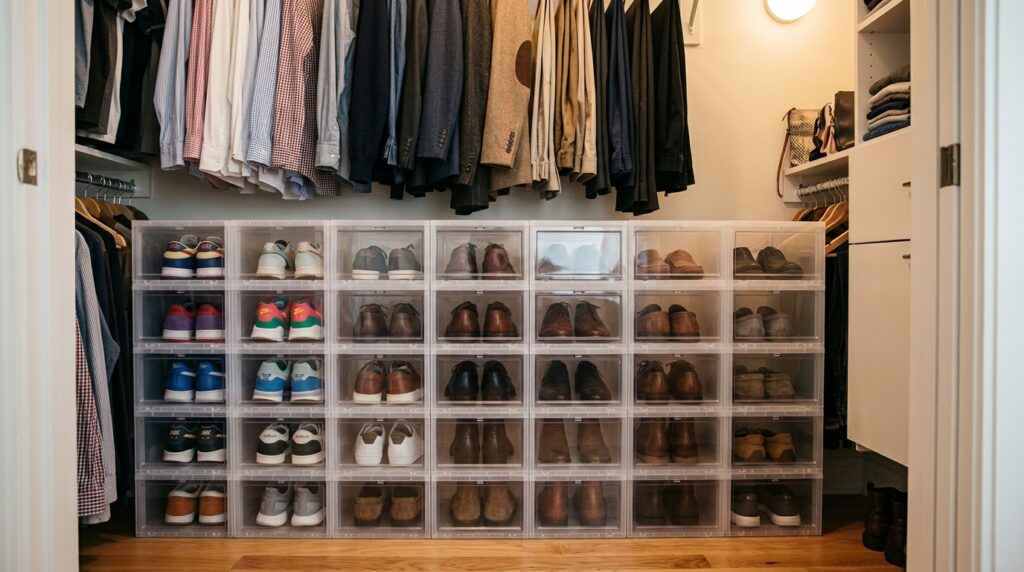
🔗 Our Top Pick: Shoe Storage Boxes Fit US 14 Clear Plastic Stackable Shoe Organizer (Amazon)
Over-the-door organizer. The back of the closet door is usable storage space. An over-door organizer with pockets holds accessories, belts, scarves, small bags, and anything else that gets lost in drawers.
Shelf dividers. For shelves with folded sweaters and jeans, shelf dividers keep piles from toppling into each other. They slide onto most standard shelf widths without any installation.
Hooks inside the closet. A few adhesive or screw-in hooks inside the closet — on the walls or on the rod itself — are useful for hanging bags, belts, robes, or tomorrow’s outfit.
Good lighting. A dark closet is an underused closet. LED strip lights or a battery-operated puck light inside the closet makes everything visible and easy to find. This is a $10–$20 upgrade that makes a real difference.
How to Keep It Organized
A closet organized once and never maintained reverts to chaos within months. The system needs habits to sustain it.
Put things back immediately. Clothes pulled out and not worn go back on the hanger right then — not on the chair, not on the floor. This single habit is more important than any organizational system.
One in, one out. Every time a new item comes into the closet, an existing item leaves. This prevents the gradual accumulation that caused the original chaos.
Seasonal swap twice a year. In spring, move winter items to storage. In fall, move summer items out. This keeps the closet populated only with current-season clothes and cuts the crowding in half.
Quick weekly reset. Five minutes on Sunday to return misplaced items, re-hang anything on the floor, and straighten piles. This prevents small disorder from becoming big disorder.
Frequently Asked Questions
How do I organize a small closet with no space?
Small closets benefit most from three changes: slim velvet hangers (reclaim 30–40% rod space), a double hang rod for short items (double the hanging capacity), and moving off-season clothes out entirely. A closet with only current-season, well-fitting clothes and slim hangers feels significantly larger than the same space packed with everything you own.
Should I fold or hang jeans and pants?
Hang dress pants and slacks to prevent creasing. Jeans can go either way — hanging takes rod space but keeps them wrinkle-free; folding takes shelf space but is more efficient for large collections. If you have more shelf space than rod space, fold. If you have more rod space, hang.
How do I organize shoes in a closet?
The most space-efficient shoe storage is clear stackable boxes (protect shoes, visible, stackable) or an angled shoe shelf on the floor under short-hang sections. Avoid piling shoes in a heap on the floor — it damages them and makes finding a matching pair a daily frustration. Keep only the shoes you actually wear in the closet; store off-season or rarely worn shoes in boxes elsewhere.
What’s the best closet organizer system?
For reach-in closets, a modular wire or laminate system (like ClosetMaid or SONGMICS) gives the most flexibility for the price. For walk-in closets, a custom system from a store like The Container Store or IKEA PAX offers more configuration options. The best system is the one you’ll actually install and maintain — a simple double rod and shelving unit beats an elaborate custom system you never finish setting up.
How long does it take to organize a closet?
A standard bedroom reach-in closet takes 2–4 hours: 1–2 hours to declutter and sort, 30–60 minutes to install any new storage components, and 30–60 minutes to put everything back in its place. Walk-in closets take 4–8 hours. The decluttering is always the longest part — once that’s done, the physical organization goes quickly.
The Bottom Line
Closet organization is a two-part problem: too much stuff and not enough system. Solve both and the result is a closet that makes getting dressed easier, keeps things visible, and stays organized with minimal daily effort.
Start with the declutter — nothing else matters until you’ve reduced to only what you actually wear. Then maximize vertical space with a double rod and slim hangers, group by category, and put daily items at eye level. The accessories come last, after the system is working.
Related posts (internal links):