
This post contains affiliate links. If you buy through our links, we may earn a small commission at no extra cost to you.
Hardwood floors are one of the most durable features in a home — but also one of the easiest to damage with the wrong cleaning method. Steam mops, excess water, harsh chemicals — any of these can dull the finish, warp the boards, or cause permanent damage over time.
The good news: cleaning hardwood correctly is simple. The right tools and products cost less than the wrong ones, and take about the same amount of time.
Here’s exactly what to do — and what to avoid.
Quick answer: For routine cleaning: dry dust mop or vacuum daily, damp mop weekly with a hardwood-specific cleaner like Bona. Never use steam mops, vinegar, or excess water. For deep cleaning: use Bona Professional or a pH-neutral hardwood cleaner with a barely damp microfiber mop. Always dry immediately.
Know Your Floor First (Finished vs. Unfinished, Solid vs. Engineered)
The right cleaning method depends on your floor type. Using the wrong approach — especially on unfinished or waxed floors — can cause damage that’s expensive to reverse.
| Floor type | How to identify | Cleaning approach |
| Surface-finished (polyurethane) | Shiny or satin sheen, water beads up | Hardwood-specific cleaner, damp mop — most common type |
| Wax-finished (older floors) | Low sheen, water soaks in slightly | Dry methods only + periodic wax. No wet mopping. |
| Unfinished hardwood | Matte, rough texture, absorbs water instantly | Dry methods only — no liquids at all |
| Engineered hardwood | Looks like wood, often in basements/kitchens | Same as surface-finished but even more moisture-sensitive |
💡 Pro tip: Not sure what finish you have? Put a few drops of water on an inconspicuous spot. If it beads up, you have a surface finish (polyurethane). If it soaks in or darkens the wood, you have a wax finish or unfinished floor.
What You’ll Need
The right tools make the difference between a safe clean and an accidental refinishing job:
- Microfiber dust mop or electrostatic dry mop — for daily sweeping
- Vacuum with a hardwood floor attachment — avoid beater bars, they scratch
- Microfiber flat mop — for damp mopping (NOT a string mop)
- Hardwood floor cleaner — Bona is the industry standard
- Two buckets (optional) — one clean solution, one rinse
- Soft cloths — for spot cleaning and drying
🔗 Our Top Pick: Bona Hardwood Floor Cleaner Spray (Amazon)
🔗 Our Top Pick: Turbo Microfiber Mop Floor Cleaning System (Amazon)
⚠️ Never use a steam mop on hardwood floors — finished or unfinished. The heat and moisture penetrate the finish and can cause warping, swelling, and finish delamination. This applies to engineered hardwood too.
Daily and Weekly Cleaning Routine
Daily (5 minutes): Dry dust mop or vacuum to remove grit, dirt, and pet hair. This is the most important step — abrasive particles act like sandpaper underfoot and scratch the finish faster than almost anything else.
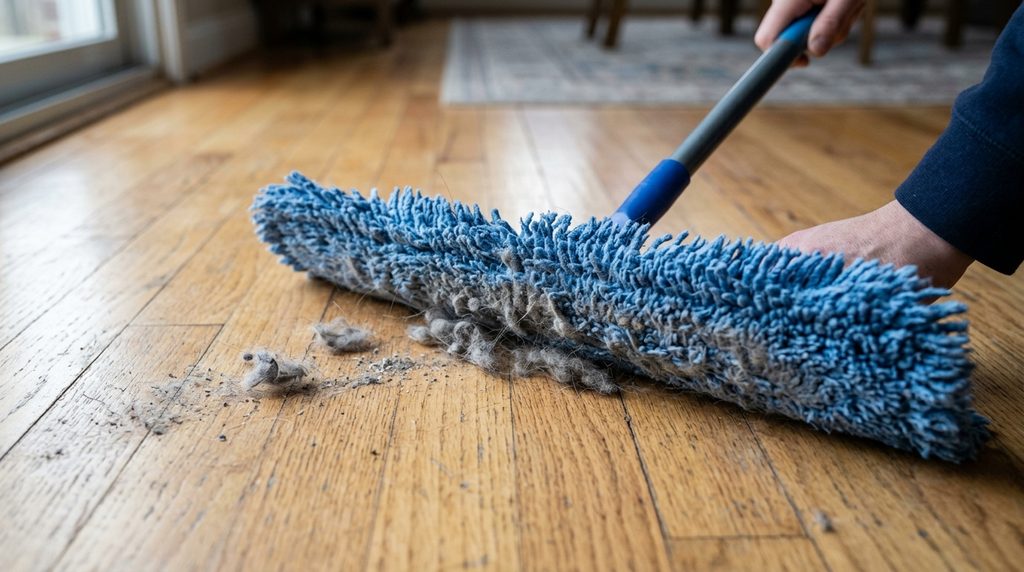
💡 Pro tip: Use a microfiber dust mop rather than a broom. Brooms push debris around and can scratch the surface. Microfiber traps particles and lifts them off the floor.
Weekly (15–20 minutes): Damp mop with a hardwood-specific cleaner. The key word is damp — not wet. Wring the mop until it’s barely moist. Standing water is the enemy of hardwood floors.
How to damp mop correctly:
- Spray the cleaner directly on the mop head, not the floor — or use a spray-and-mop system like Bona
- Work in the direction of the wood grain
- Overlap your passes slightly to avoid streaking
- Follow immediately with a dry microfiber cloth if any moisture remains
- Never let water pool or sit on the surface
How to Deep Clean Hardwood Floors
Deep cleaning removes built-up residue, dulling agents, and embedded grime that routine mopping misses. Do this 2–4 times per year, or whenever the floor looks dull despite regular cleaning.
Step 1: Clear the room. Move furniture and area rugs. You need full access to the floor.
Step 2: Dry clean thoroughly. Vacuum every inch, including along baseboards and in corners. Any grit left behind will get dragged around during wet cleaning.
Step 3: Apply hardwood floor cleaner. Use a concentrated hardwood cleaner like Bona Professional Series or Rejuvenate All Floors Restorer. Apply with a barely damp microfiber mop, working in 4×4 foot sections.
Step 4: Work in the direction of the grain. Always clean with the grain — going against it can push dirt into the gaps between boards.
Step 5: Dry immediately. Follow each section with a dry microfiber cloth. Don’t let cleaner sit on the surface.
Step 6: Allow to dry completely. Keep foot traffic off the floor for at least 30 minutes after deep cleaning.
🔗 Our Top Pick: Bona Professional Series Hardwood Floor Cleaner (Amazon)
What Never to Use on Hardwood Floors
This list matters as much as the cleaning methods. The wrong product can void your floor warranty and cause damage that requires professional refinishing to fix.
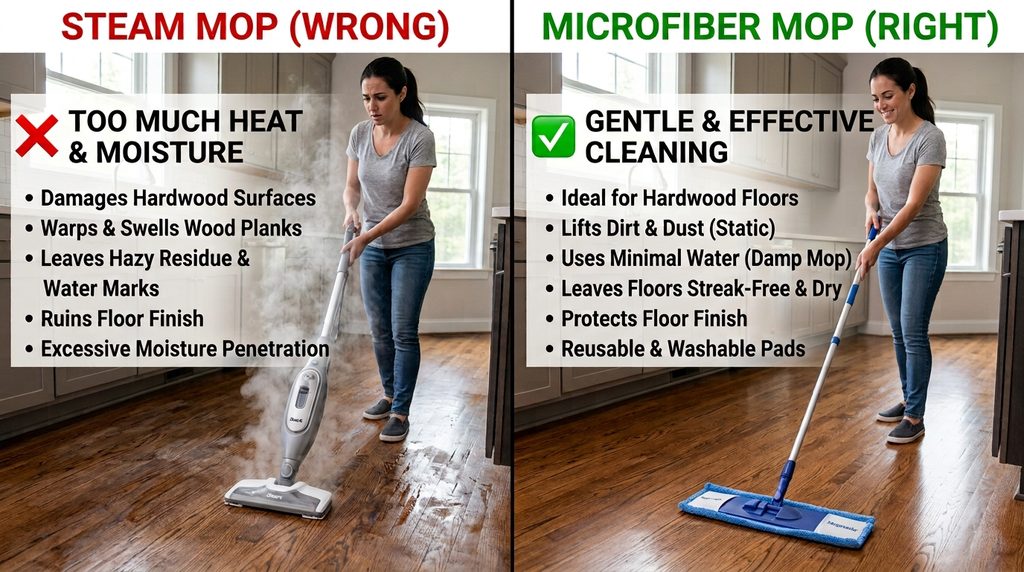
| Never use | Why it damages hardwood |
| Steam mops | Heat + moisture penetrates finish, causes warping and delamination |
| Vinegar or vinegar-based cleaners | Acid degrades polyurethane finish over time, causes dulling |
| Dish soap or all-purpose cleaners | Leaves residue, dulls finish, attracts more dirt |
| Ammonia-based cleaners (Windex, etc.) | Breaks down finish, causes discoloration |
| Oil soaps (Murphy’s) on polyurethane floors | Leaves waxy buildup that dulls finish — ok on wax-finish floors only |
| Wet string mops | Too much water — causes swelling, warping, and finish damage |
| Abrasive scrubbers | Scratches finish permanently |
⚠️ Vinegar is commonly recommended online as a ‘natural’ hardwood cleaner. It is not safe for polyurethane-finished floors. The acetic acid slowly degrades the finish, causing permanent dulling that can’t be fixed without refinishing.
How to Handle Common Stains
Water stains and white rings: Apply a small amount of hardwood floor cleaner and rub gently with a soft cloth in the direction of the grain. For stubborn white rings, a tiny amount of mineral spirits on a cloth can work — test in an inconspicuous area first.
Pet urine: Blot immediately — don’t rub. Apply an enzyme-based pet cleaner specifically safe for hardwood. Urine that soaks through the finish can permanently stain or damage the wood. Act within minutes if possible.
Grease or oil: Apply a small amount of dish soap directly to the spot, let sit 1 minute, then wipe with a damp cloth and dry thoroughly. Rinse well — dish soap leaves residue if not fully removed.
Scuff marks: Rub gently with a clean tennis ball or a microfiber cloth. Most scuffs are surface marks on the finish, not the wood itself, and come off with light friction.
Candle wax or gum: Harden with ice in a plastic bag, then gently scrape with a plastic scraper (never metal). Clean residue with a hardwood cleaner.
💡 Pro tip: Act fast on any spill. The longer liquid sits on hardwood, the greater the risk of penetrating the finish and staining the wood underneath.
How to Keep Hardwood Floors Looking New Longer
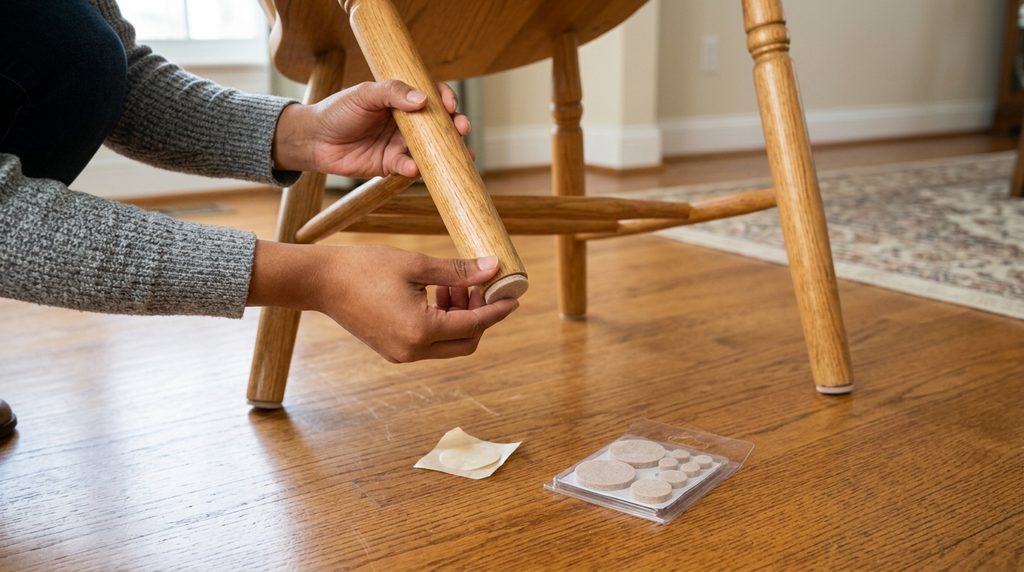
Use felt pads on all furniture legs. Dragging chairs and tables is the #1 cause of scratches on hardwood. Stick-on felt pads cost a few dollars and last for years.
Place rugs in high-traffic areas. Entryways, hallways, and in front of the kitchen sink take the most abuse. A rug protects the finish and traps grit before it reaches the wood.
Trim pet nails regularly. Dog nails on hardwood create fine scratches over time that accumulate into visible wear patterns.
Control humidity. Hardwood expands and contracts with humidity changes. Keep indoor humidity between 35–55% year-round. Levels outside this range cause gapping (too dry) or cupping (too humid).
Refinish before it’s too late. Surface-finished floors can be screen-and-recoated (a light sanding + new topcoat) every 3–5 years without losing wood thickness. This is far cheaper than a full sand-and-refinish job and keeps the floor looking new.
Frequently Asked Questions
Can I use a Swiffer on hardwood floors?
The dry Swiffer (with dry cloths) is fine for daily dust and debris. The Swiffer WetJet is not recommended for hardwood — it applies too much moisture and the cleaning solution isn’t formulated for hardwood finishes. Stick to a dedicated hardwood cleaner and a microfiber mop for wet cleaning.
How often should I clean hardwood floors?
Dry sweep or vacuum daily in high-traffic areas (or at least every other day). Damp mop weekly. Deep clean 2–4 times per year. If you have pets or kids, increase frequency across the board — grit and spills are harder on hardwood than any cleaner.
My hardwood floors look dull even after cleaning. What’s wrong?
Dulling usually comes from one of three things: product buildup from incorrect cleaners (dish soap, Murphy’s Oil Soap, or vinegar), worn finish that needs recoating, or micro-scratches from grit. Switch to a pH-neutral hardwood cleaner like Bona and give the floor 2–3 proper cleanings. If it’s still dull, the finish may need a screen-and-recoat.
Is Murphy Oil Soap good for hardwood floors?
Murphy Oil Soap is designed for wax-finished hardwood — it was formulated decades ago when most floors had oil or wax finishes. On modern polyurethane-finished floors, it leaves a residue that builds up over time and dulls the finish. If your floor has a polyurethane finish (most floors installed after 1970), use a hardwood-specific cleaner like Bona instead.
How do I know if my hardwood floor needs refinishing vs. just cleaning?
Do the water test in a low-traffic area: if water beads up, the finish is intact and cleaning will restore the look. If water soaks in quickly, the finish is worn through and refinishing is needed. Also look for deep scratches that go through the finish into the wood itself — those require sanding, not cleaning.
The Bottom Line
Cleaning hardwood floors correctly comes down to one rule: keep moisture minimal and use the right product. A microfiber dust mop daily, a barely damp mop with Bona weekly, and a deep clean a few times a year is all most floors need to look great for decades.
The mistakes that damage hardwood — steam, vinegar, excess water, wrong cleaners — are all easy to avoid once you know what they are. Stick to the routine above and your floors will outlast everything else in the room.
Related posts (internal links):