
This post contains affiliate links. If you buy through our links, we may earn a small commission at no extra cost to you.
Most homeowners fertilize their lawn at the wrong time, in the wrong amount, or with the wrong product — and then wonder why it doesn’t look any better.
Fertilizing is simple once you understand two things: what your grass actually needs and when it needs it. Get those right and a bag of fertilizer does more work than years of guesswork.
Here’s the complete guide — no filler, no fluff.
Quick answer: For cool-season grass, the most important fertilizer application is in fall (September–November) with a second application in late spring. For warm-season grass, fertilize from late spring through summer. Use a slow-release fertilizer, apply at the rate on the bag, and always water in after applying.
What the Numbers on Fertilizer Bags Actually Mean (N-P-K)
Every fertilizer bag shows three numbers — like 32-0-10 or 12-12-12. These represent the percentage by weight of three nutrients:
| Number | Nutrient | What it does |
| First (N) | Nitrogen | Drives leaf and blade growth — responsible for green color and density |
| Second (P) | Phosphorus | Supports root development — most important for new grass and seedlings |
| Third (K) | Potassium | Builds stress tolerance — helps grass survive drought, cold, and disease |
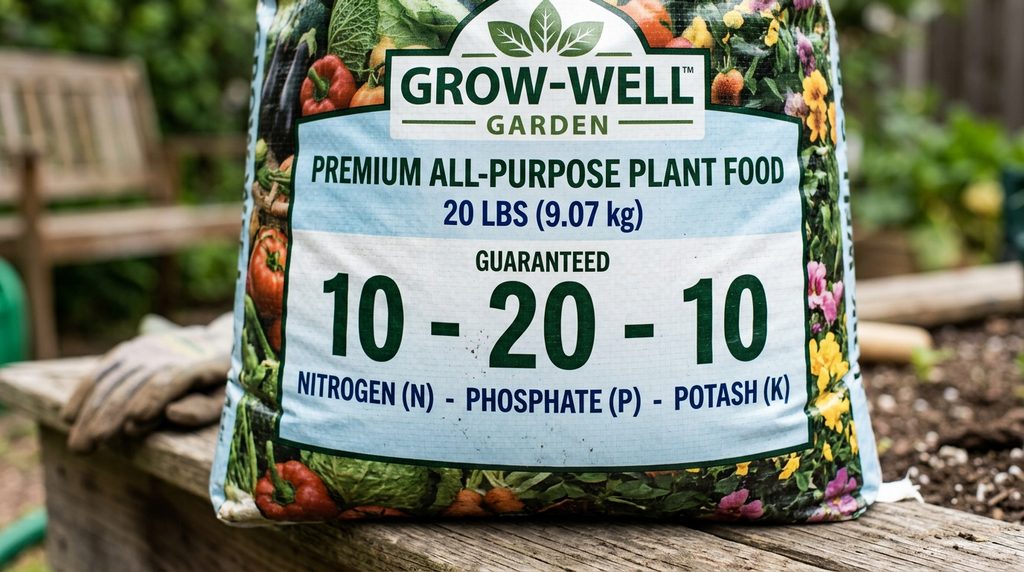
For established lawns: you mostly need nitrogen (N) and potassium (K). A bag labeled 32-0-10 has 32% nitrogen, no phosphorus, and 10% potassium — typical for a maintenance fertilizer.
For new grass or after overseeding: use a starter fertilizer with higher phosphorus (the middle number), like 12-12-12 or 18-24-12. See our guide: How to Overseed a Lawn in Fall.
💡 Pro tip: Most established lawns don’t need phosphorus — and in many states, applying it to existing lawns is restricted because it runs off into waterways. Check your local regulations before using a high-P fertilizer on an established lawn.
Types of Fertilizer: Slow-Release vs. Fast-Release
| Type | How it works | Best for |
| Slow-release (coated or organic) | Releases nutrients gradually over 6–12 weeks | Most homeowners — lower burn risk, longer feeding |
| Fast-release (water-soluble) | Available to grass immediately after watering | Quick green-up when lawn is visibly deficient |
| Organic (Milorganite, compost) | Feeds soil microbes which release nutrients slowly | Environmentally conscious, low burn risk, soil building |
Recommendation: Use slow-release for most applications. It’s harder to over-apply, less likely to burn the lawn, and feeds consistently over weeks rather than giving a burst followed by nothing.
🔗 Our Top Pick: Milorganite Slow-Release Nitrogen Fertilizer (Amazon)
🔗 Our Top Pick: Green Thumb GT58105 Winterizer Lawn Fertilizer (Amazon)
When to Fertilize — Schedule by Grass Type
Timing matters more than almost anything else. Fertilize at the wrong time and you’re feeding weeds, burning stressed grass, or wasting product on dormant turf.
Cool-season grass schedule (Kentucky bluegrass, tall fescue, ryegrass — northern US):
| Application | Timing | Product |
| Fall feeding (most important) | September–November | High-N fertilizer like 32-0-10 or Scotts Turf Builder Fall |
| Late spring feeding | May–June | Balanced fertilizer — avoid high N in summer heat |
| Optional: early spring | March–April | Light feeding only — skip if lawn looks healthy |
Warm-season grass schedule (Bermuda, Zoysia, St. Augustine — southern US):
| Application | Timing | Product |
| First feeding | Late spring (May) — after grass greens up | High-N fertilizer |
| Summer feeding | June–July | Balanced or slow-release |
| Last feeding | August — 6 weeks before first frost | Low-N, higher K for winter hardening |
⚠️ Never fertilize dormant grass. Applying nitrogen to grass that isn’t actively growing feeds weeds instead and can burn the lawn when it comes out of dormancy. Cool-season grass goes semi-dormant in summer heat; warm-season grass goes dormant in winter.
How Much Fertilizer to Apply
Over-applying fertilizer is one of the most common lawn mistakes — it burns grass, wastes money, and pollutes waterways. The bag tells you exactly how much to use. Follow it.
The 1 lb nitrogen rule: Most lawn care guidelines recommend applying no more than 1 lb of actual nitrogen per 1,000 sq ft per application. Here’s how to calculate it:
- Find the nitrogen percentage on the bag (first number). Example: 32-0-10 = 32% nitrogen.
- Divide 100 by that percentage: 100 ÷ 32 = 3.1 lbs of fertilizer per 1,000 sq ft.
- Apply 3.1 lbs per 1,000 sq ft to deliver exactly 1 lb of nitrogen.
💡 Pro tip: Measure your lawn area before buying fertilizer. Most bags cover 5,000–15,000 sq ft. Buying the right amount prevents over-application and wasted product.
🔗 Our Top Pick: Scotts Turf Builder EdgeGuard Spreader (Amazon)
Step-by-Step: How to Fertilize Your Lawn
Step 1: Check the weather. Apply fertilizer when no rain is expected for 24 hours (so it doesn’t wash away) but water the lawn within 24–48 hours after applying (to activate it). Avoid applying in extreme heat above 85°F.
Step 2: Mow first. Fertilize on recently mowed grass so the product reaches the soil rather than sitting on tall blade tips. Wait at least 24 hours after mowing before applying.
Step 3: Set your spreader correctly. Every fertilizer bag lists spreader settings for common brands. Use the recommended setting — don’t guess. Start with the setting and adjust after your first pass if coverage looks uneven.
Step 4: Apply in two passes. Make one pass across the lawn, then a second pass perpendicular to the first. Use half the recommended rate on each pass. This gives even coverage and prevents streaking.
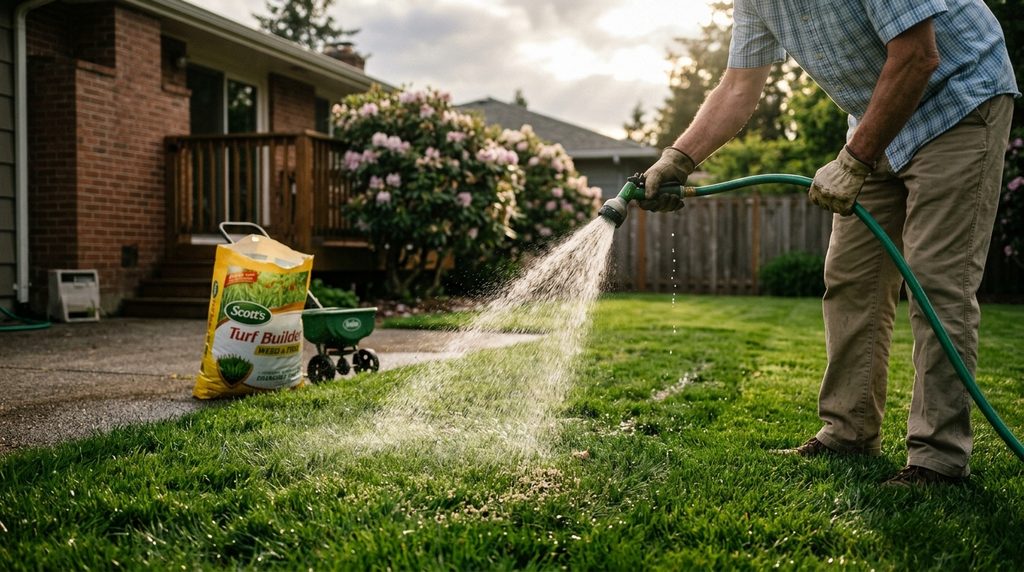
Step 5: Water it in. Apply about ¼ inch of water within 24 hours of fertilizing. This washes the fertilizer off the grass blades (preventing burn) and moves it into the soil where roots can absorb it.
Step 6: Clean your spreader. Fertilizer is corrosive. Rinse your spreader with water after every use or the metal parts will corrode and the calibration will drift over time.
⚠️ Keep fertilizer off driveways, sidewalks, and storm drains. Sweep any spilled granules back onto the lawn immediately — fertilizer that washes into waterways contributes to algae blooms and water quality problems.
Common Fertilizing Mistakes (and What They Cost You)
Fertilizing in summer heat. High nitrogen on stressed, semi-dormant cool-season grass in July or August causes fertilizer burn and can seriously damage or kill the lawn. Skip summer applications for cool-season grass.
Using the wrong product. A weed-and-feed fertilizer applied before overseeding will prevent your grass seed from germinating — the herbicide component blocks all seed germination, not just weeds. Separate these tasks by at least 8 weeks.
Skipping the fall application. For cool-season grass, fall is the most critical feeding of the year. Grass is actively storing energy for winter and spring growth. Missing the fall application is like skipping the most important meal of the day.
Over-applying. More fertilizer doesn’t mean more results. Excess nitrogen causes rapid, weak growth that’s more susceptible to disease, and the surplus leaches into groundwater. Follow the bag rate.
Not watering it in. Fertilizer granules sitting on dry grass burn leaf tissue. Always water within 24 hours of applying granular fertilizer.
Frequently Asked Questions
How often should I fertilize my lawn?
Cool-season lawns: 2–3 times per year (fall is mandatory, late spring is important, early spring is optional). Warm-season lawns: 3–4 times per year from late spring through late summer. More frequent applications are rarely beneficial and increase the risk of burn and runoff.
Can I fertilize and overseed at the same time?
Yes, but use a starter fertilizer — not a regular lawn fertilizer. Starter fertilizers are high in phosphorus (the middle number), which supports root development in new seedlings. Apply the starter fertilizer at the same time as the seed, then follow up with a regular maintenance fertilizer 6–8 weeks later. See: How to Overseed a Lawn in Fall.
What’s the best fertilizer for a green lawn fast?
Fast-release nitrogen fertilizers (water-soluble, like ammonium sulfate) green up a lawn quickly — usually within 3–5 days. The downside: the green-up doesn’t last as long and the risk of burn is higher. For a quick fix before an event, a fast-release product works. For long-term lawn health, slow-release is better.
Is organic fertilizer better than synthetic?
Organic fertilizers like Milorganite are gentler, improve soil health over time, and have virtually no burn risk. Synthetic fertilizers are more concentrated and precise. For most homeowners, a slow-release synthetic is the practical choice. Organic is worth considering if you’re building long-term soil health or have pets and kids on the lawn frequently.
Can I fertilize after aerating?
Yes — and you should. Aeration opens channels in the soil that allow fertilizer to reach the root zone far more effectively than on un-aerated soil. The ideal fall sequence: aerate → overseed → apply starter fertilizer → water. See: How to Aerate a Lawn.
The Bottom Line
Lawn fertilizing doesn’t need to be complicated. Know your grass type, follow the seasonal schedule, use a slow-release product, apply at the right rate, and water it in. Do that consistently and your lawn will out-compete weeds, recover faster from stress, and look noticeably better within one growing season.
For cool-season grass, if you only do one thing — make it the fall feeding. That single application does more for your lawn than anything else in the calendar year.
Related posts (internal links):